

The Migraine Aura Scan in Brief
A short introduction for those who don't yet have a password but want to know what the MigraineAuraScan — the Aura Anamnesis from the Migraine Aura Foundation — does.
Imagine a world where you no longer sit in the waiting room trying to compress months into five sentences — but instead walk into the consultation with an ordered report of your own symptoms in hand. The conversation begins where it usually ends.
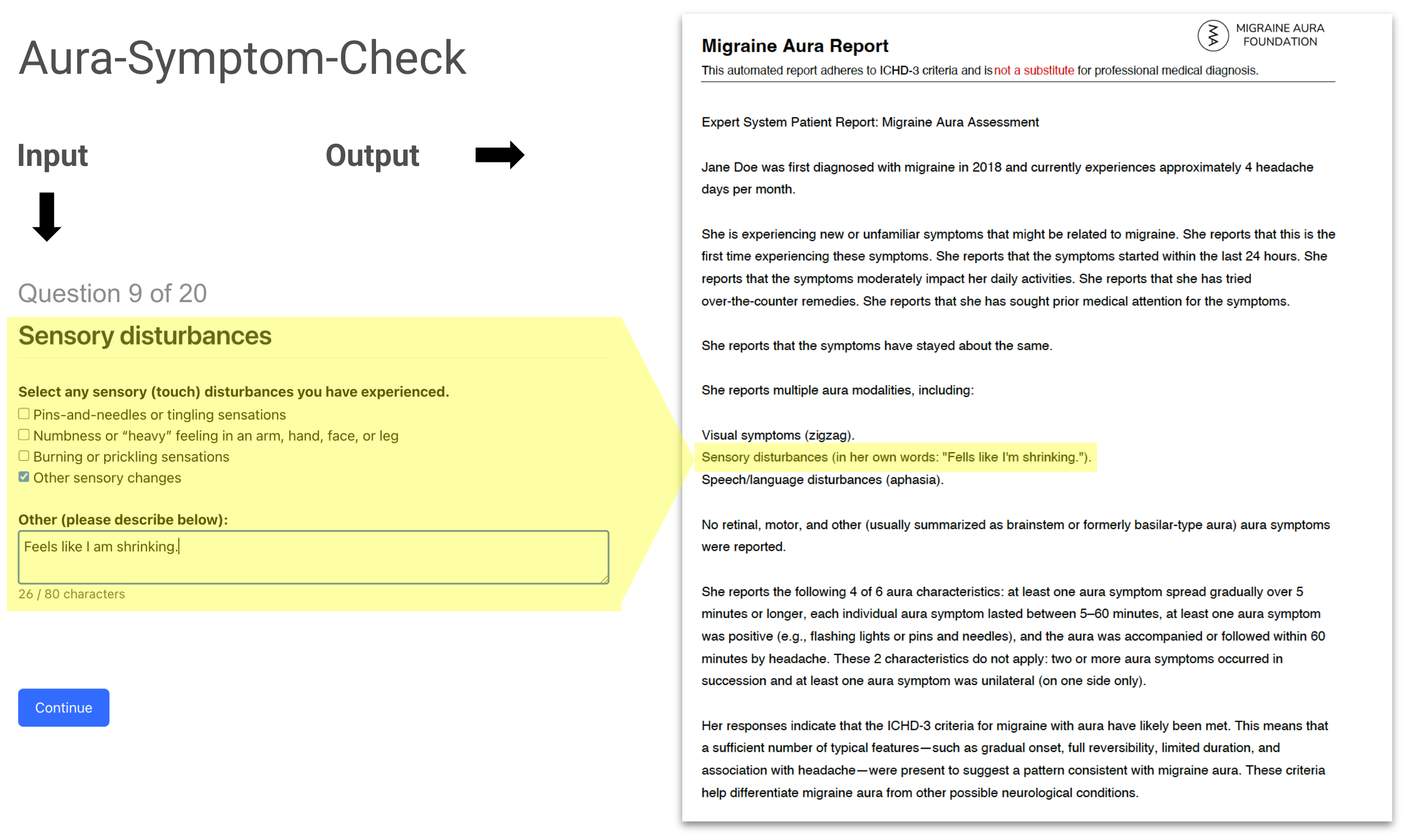
That is the goal of the MigraineAuraScan — the structured Aura Anamnesis from the Migraine Aura Foundation. But the mission needs more than one tool: alongside it, headache phenotyping (from the migraine DiGA M-sense, tested in over 300 million headache-days) and the MigraineBrainRadar™ are advancing in parallel.
Bringing three things together
At the center sits a symbolic AI expert system. Symbolic means: no chatbot, and therefore no black box — but transparent rules grounded in the ICHD-3 diagnostic criteria of the International Headache Society. Every question, every conclusion is openly traceable.
As input, the system needs a translation — between the patient’s narrative experience and the formal language of diagnostics. That translation draws on the rich archive of the foundation’s website: over 7,000 lived accounts (read same Voices), gathered since 1998. At every step of the questionnaire, patients can look up how others described something similar — and so subjective illness experience becomes comparable.
As output, an automated consultation letter is generated, in the style of a tele-consult. Readable by a clinician in 30 seconds, delivered as a PDF to bring to the appointment.
The core idea
The Aura Anamnesis thus connects two worlds that rarely meet in routine care: the narrative experience of patients and the formal language of diagnostics. Not interrogated — but guided through the criteria.
Three shifts follow:
- From isolation to comparability. What feels unique and barely describable acquires a shape and a place where it resonates.
- From self-doubt to language. What was hard to put into words becomes a clearly documented observation — not as the system sees it, but as the patient does.
- From consultation to shared decision making. When patient and physician start from the same ICHD-3-based finding, the conversation begins on equal footing.
Why symbolic AI — and not an LLM
In medicine, what matters is not only what a system outputs, but why. A language model produces plausible sentences but cannot reliably disclose its derivation. A symbolic expert system can: every statement in the consultation letter traces back to the specific ICHD-3 question that was answered — for the patient, for the physician, for a second opinion.
That is the wager of this tool: that combining collective experiential knowledge, formal diagnostic logic, and a shareable report yields more than any of these parts alone.
For a deeper dive, the longer post “Migraine Aura Check: Recognizing the Unrecognized” explains effects, risks, and validation in detail.