

Overview
Oliver Sacks was a renowned neurologist, author, and physician whose 1970 book Migraine became the foundational popular account of the condition—a work that transformed how both patients and medical professionals understood migraine’s complexity. Drawing on clinical observation, case studies, and his own experiences as a migraine sufferer, Sacks presented migraine not as a simple vascular headache but as a profound neurological phenomenon worthy of serious scientific and philosophical attention.
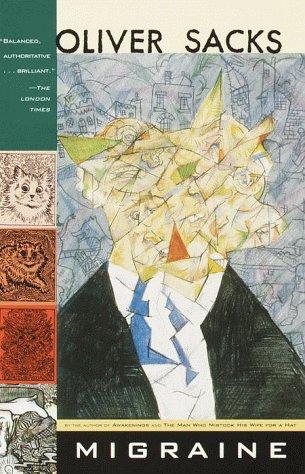
Migraine explored the condition’s history, physiology, phenomenology, and psychological dimensions. Sacks investigated migraine aura with the precision of a neuroscientist and the empathy of someone who had lived through the experience. He documented the variety of aura symptoms—visual phenomena, disturbances of speech and perception, the transformation of bodily awareness—and argued that migraine offered a unique window onto how the brain constructs perception and consciousness itself.
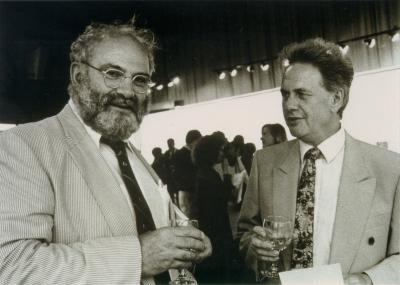
Sacks collaborated closely with Derek Robinson, the originator of the Migraine Art concept, and the two appeared together at the landmark Mosaic Vision exhibition at the San Francisco Exploratorium in 1991. This collaboration reflected Sacks’s conviction that artistic representations of migraine—drawings, paintings, and visual narratives created by migraine sufferers—provided invaluable data for understanding the subjective reality of the experience. He championed the idea that migraine could be studied not only through clinical instruments but through the witness of those who experienced it directly.
In his later memoir On the Move (2015), published just before his death, Sacks revisited his own migraine experiences with the reflective wisdom of a lifetime. He presented migraine as inseparable from his identity as a scientist and writer—a condition that had shaped his curiosity about the brain and his commitment to understanding illness through the patient’s perspective.
Sacks’s legacy is profound: he demonstrated that migraine, long dismissed as a merely functional or psychosomatic complaint, deserved rigorous neurobiological investigation alongside serious humanistic inquiry. His work opened doors for future research and, equally importantly, validated the experiences of millions of migraine sufferers by showing that their condition was worthy of intellectual seriousness and artistic attention.