
Overview
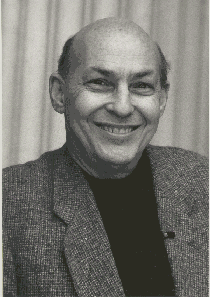
Marvin Minsky was a pioneering cognitive scientist and co-founder of the Artificial Intelligence Laboratory at MIT, one of the architects of modern computer science. His intellectual interests ranged across mathematics, philosophy, neuroscience, and the fundamental nature of mind and consciousness. Throughout his career, Minsky brought a scientist’s precision and a thinker’s depth to questions that most would dismiss as too abstract or too personal for serious investigation.
Minsky’s migraine aura experiences became the subject of his own scientific curiosity. At age 17, during a snowstorm, he experienced autoscopy—the disturbing hallucination of seeing himself from outside his body, watching himself cross a field from a height of ten meters. He recognized it immediately as a migraine hallucination and, with characteristic intellectual composure, deliberately interrupted the experience by starting a social conversation, aware from his reading of William James that such experiences could be transformative in unwanted ways.
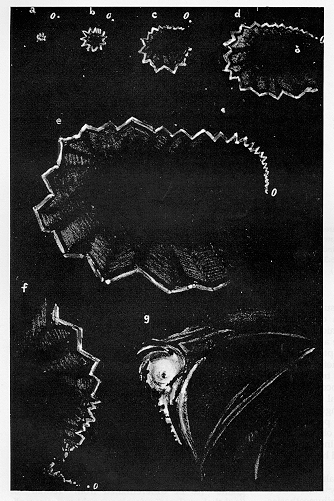
Later, Minsky encountered a scintillating scotoma—the visual aura phenomenon he remembered from Duke-Elder’s Textbook of Ophthalmology. Observing a tree that appeared to flicker and shimmer with jagged, pulsating, colorful outlines, he recognized the experience as a migraine aura and anticipated the headache that would follow. This convergence of lived experience and medical knowledge allowed him to appreciate the phenomenon both as a sufferer and as a scientist documenting it.
Minsky’s engagement with migraine was not merely personal. His essays on the subject demonstrate how migraine aura—the hallucinatory distortions of perception and body image—illuminate the brain’s mechanisms for constructing reality. The fact that the brain can generate entire alternative perceptions, complete visual worlds that feel absolutely real, suggested to him deep truths about consciousness and the constructive nature of perception. Migraine aura became a natural experiment in neuroscience, revealing how perception is actively generated rather than passively received.
For Minsky, the migraine aura was a window onto human consciousness itself—a reminder that the mind is more malleable, more mysterious, and more subject to internal variation than everyday experience suggests. His willingness to document and reflect on these experiences contributed to a broader scientific culture in which migraine is taken seriously as a phenomenon worthy of philosophical and neurobiological scrutiny.