

Overview
Migraine sufferers have depicted their symptoms through visual representation for centuries, long before Derek Robinson coined the term “Migraine Art” in the 1970s. This historical lineage reveals that the impulse to translate migraine’s peculiar sensations into pictorial form is ancient, suggesting something fundamental about the nature of visual aura and the human need to communicate experiences that words alone cannot adequately convey.
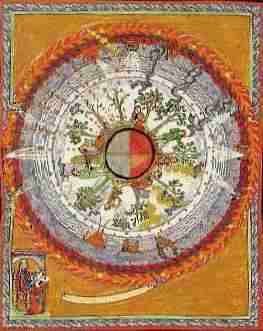
The earliest known artistic representation of visual migraine aura appears in the medieval illuminated manuscript “Scivias” (Visions) of Hildegard of Bingen, dating to approximately 1151–1152. Hildegard, a 12th-century abbess, mystic, and polymath, experienced profound visual phenomena that contemporary scholars and neuroscientists have identified as consistent with migraine aura with or without basilar features. Her miniature illuminations depict swirling, radiating patterns of light and geometrical forms that bear striking resemblance to the visual phenomena described by modern migraine sufferers. Hildegard’s representations predate the first medical illustration of scintillating scotoma by nearly 700 years.
The transition from mystical to medical representation came in 1845, when Christian Georg Theodor Ruete published an ophthalmological textbook containing what is recognized as the first medical illustration of the scintillating scotoma—the characteristic zigzagged or fortified visual disturbance of migraine aura. Ruete’s image establishes a turning point: the moment when migraine aura entered the formal medical visual vocabulary, moving from religious vision or personal symptom to recognized pathophysiological phenomenon worthy of clinical illustration.
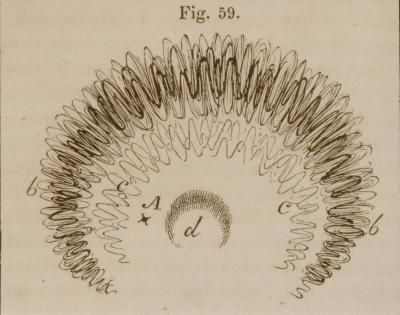
In the latter half of the 19th century, the preeminent neurologists of the era produced and published their own illustrations of migraine’s visual phenomena. Jean-Martin Charcot, the legendary founder of modern neurology, published illustrations of scintillating scotoma in 1888. Joseph Jules François Félix Babinski, one of Charcot’s students, produced illustrations in 1890 created by professional artists based on patient descriptions. Sir William Richard Gowers, the influential British neurologist whose textbook shaped medical education for decades, published an illustration of the “fortification spectrum” in 1895, rendered by the artist Mr. Beck.
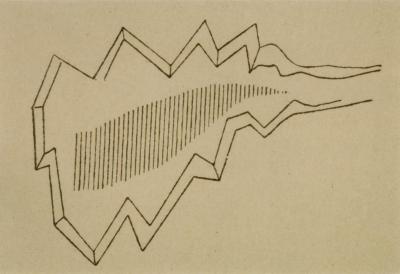
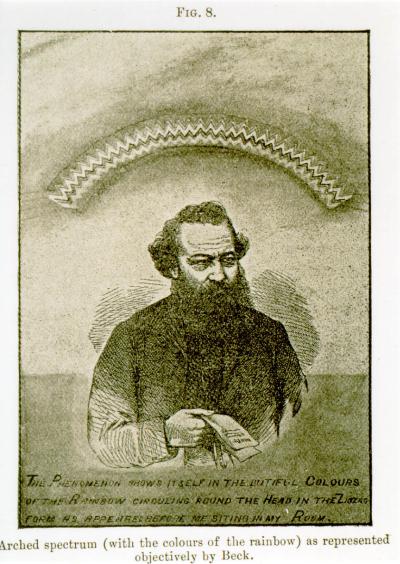
These early medical illustrations served multiple purposes. They provided a visual standard for communication among physicians, aided in patient education and diagnosis, and created a permanent record of how migraine aura had been understood and represented at successive moments in medical history. Notably, these early medical illustrations were typically produced by artists commissioned to visualize the verbal descriptions and sketches of migraine sufferers—a practice that anticipated Robinson’s later insight that sufferers themselves were the most authoritative illustrators of their own experiences.
The gap between Hildegard’s medieval visions and Ruete’s 1845 medical illustration raises profound questions about representation, knowledge, and legitimacy. What changed was not the symptom itself, but rather the authority and venue for its representation. Medieval visions were interpreted through theological frameworks; 19th-century medical illustrations were rendered through the language of pathophysiology. Derek Robinson’s Migraine Art concept, in relinquishing claims to diagnostic authority or aesthetic judgment, paradoxically returns representational power to those who actually experience migraine, honoring both the ancient tradition of personal testimony and the modern medical requirement for precise documentation.